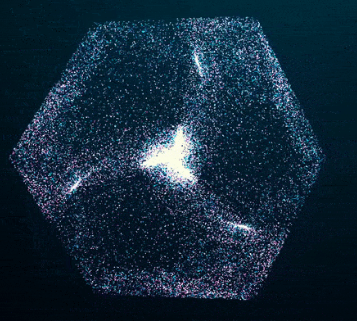
At New York University, scientists have created something that could rewrite the laws of physics, a relatively new state of matter that could revolutionize how we think about physics. This state of matter is a time crystal.
On March 22, 2026, New York scientists created a time crystal they could use to give sound waves the energy to suspend small beads in the air. This one crystal has the ability to break the laws of motion, creating a steady, constant, and stable rhythm in movement. This time crystal was created from styrofoam beads.
What are time crystals, and how are they created?
Time crystals are a state of matter that cycles through its structure in time rather than space. They can be used to create quantum computers, very efficient memory devices, and even super-precise sensors! The creation process starts by getting qubits, which are a lot like a top; they can point up or down. The scientists arrange these in random patterns, for example, up, up, down, down. Using magnetic fields, the scientists make the qubits lose energy, stopping all of their motion. Then the qubits are hit with a pulse, which could flip their directions. The scientists repeat this in a pattern. If the qubits resist the flip, you have a time crystal. Time crystals must be very cold, close to absolute zero, to exist.
Scientists are still experimenting on these physics-breaking crystals, so many more discoveries await in the near future. Assuming this happens within this school year, I will most likely report on them. For now, you can look at the works cited articles to find more information about the future of these discoveries.
Works Cited:
https://www.sciencedaily.com/releases/2026/03/260322020258.htm










Timothy Guideau • Apr 29, 2026 at 12:52 pm
Now that I think about it… It’s more like REWRITING the laws of physics. ⊙.☉
Kathleen Price • Apr 19, 2026 at 10:56 am
This story is incredible. I’ve got to get my head around it. It’s a lot to think about. Thanks for introducing me to time crystals.
Nathan • Mar 27, 2026 at 9:26 am
Wild stuff, thanks for teaching us about it!